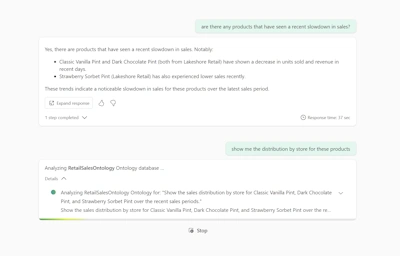
The real problem is not lack of data. It is fragmented decision-making.
Most mid-size companies already have plenty of data. The issue is that it is spread across departments, systems and reporting habits that matured at different speeds.
Finance may have reliable monthly numbers. Sales may have CRM dashboards. Operations may have spreadsheets, production reports or local tools. Some departments have strong KPIs and automation. Others still depend on manual exports and personal knowledge.
The result is a leadership problem, not only a technical one. It takes too much effort to understand what is happening across the organisation. Reports arrive late. KPIs do not always match. Accounting becomes the closest thing to a company-wide source of truth, but accounting explains financial outcomes after the fact. It does not give executives a live view of how the business is operating today.
That is why a Microsoft Fabric roadmap can be valuable for mid-size companies. Not because the business needs another platform, but because it needs a governed way to move from fragmented reporting to trusted, up-to-date decisions.
AI is leverage, not a shortcut around data quality
AI is appealing to leadership teams because it promises speed: better questions, automated workflows, faster discovery and less manual work. All of that is possible.
But AI does not fix fragmented ownership, inconsistent KPIs or poor data quality by itself. If the underlying data is scattered, incomplete or disputed, AI can make the noise faster.
For mid-size companies, AI readiness starts with BI and analytics readiness. The foundation is reliable data architecture: clear sources, governed definitions, quality controls, secure access and business-owned KPIs. AI is the accelerator on top of that foundation.
This is where Microsoft Fabric can play a strategic role. It brings data integration, engineering, warehousing, analytics, Power BI and AI capabilities into one platform. The value is not only technical consolidation. The value is creating an operating model for trusted data.
What Microsoft Fabric helps consolidate
Microsoft Fabric is designed to reduce the complexity of running separate tools for integration, storage, analytics, reporting and governance.
Key components include:
- OneLake: A unified data foundation for storing, organising and serving trusted data without unnecessary duplication, surfaced through lakehouse or data warehouse patterns.
- Data Engineering: Pipelines, notebooks and Spark capabilities for preparing, transforming and maintaining data at scale.
- Power BI: Semantic models, self-service reporting and executive dashboards.
- Data Science and AI capabilities: A path toward predictive analytics once the data foundation is reliable.
- Real-Time Intelligence: Streaming and event analytics for operational signals that need fresher monitoring.
For executives, the point is not to evaluate every workload in detail. The point is whether Fabric can reduce tool sprawl, improve governance and create a clearer route from operational data to business decisions.
A practical Microsoft Fabric roadmap for mid-size companies
A Fabric plan should not start with migration for its own sake. It should start with the decisions the business needs to make better.
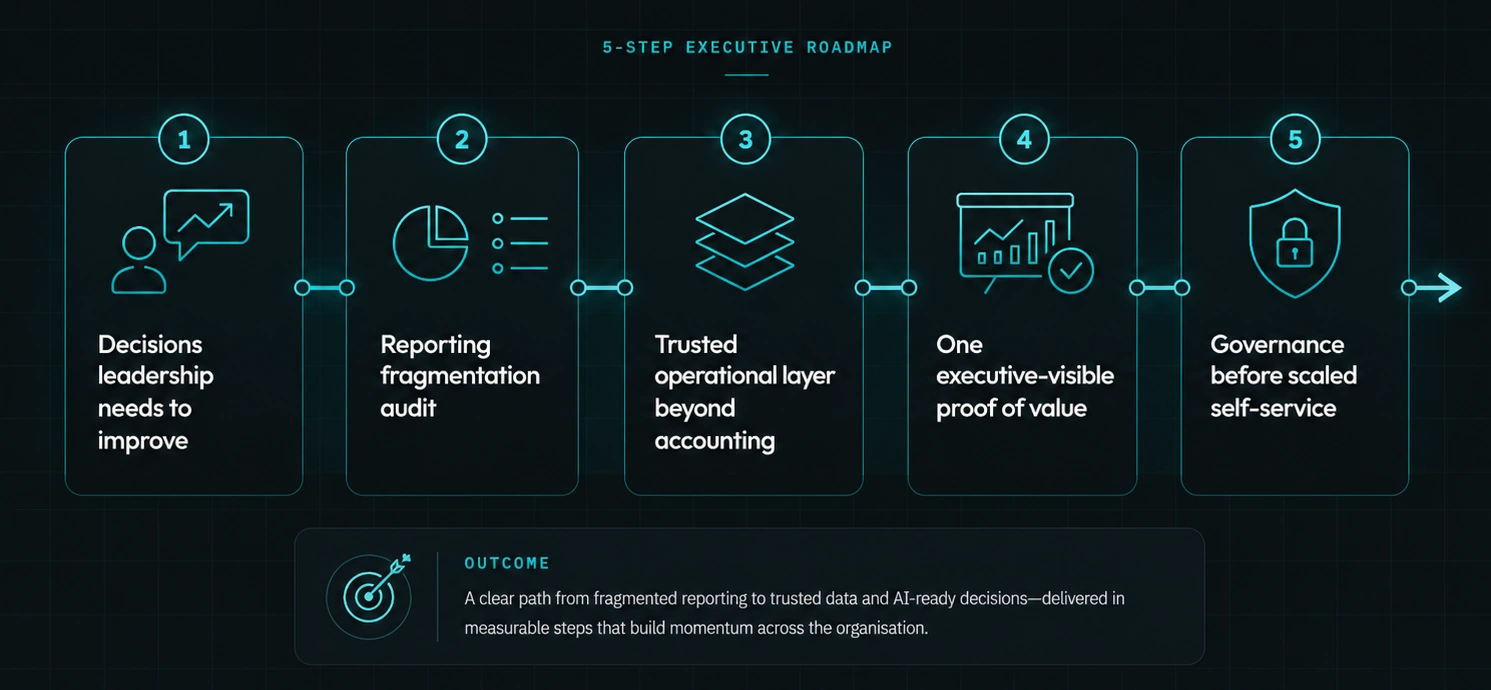
1. Start with the decisions leadership needs to improve
Start with the recurring business questions that are hard to answer today.
Examples:
- Which products, customers or regions are driving margin?
- Where are sales pipeline, delivery capacity and cash flow misaligned?
- Which operational issues are affecting customer experience?
- Which KPIs do departments interpret differently?
- Which reports take too long to prepare or reconcile?
This keeps the roadmap tied to business value and stops the platform work drifting away from executive priorities.
2. Audit reporting fragmentation and ownership
Before choosing what to build, identify where the current reporting model breaks down.
Look at:
- Departmental tools and spreadsheets
- Manual data preparation work
- Duplicate or conflicting KPIs
- Reporting delays
- Data quality issues
- Security and compliance gaps
- Licences, vendors and maintenance overhead
This is where many mid-size companies discover the hidden cost of fragmentation: time lost reconciling numbers, explaining differences and making decisions with partial confidence.
3. Define the trusted operational layer beyond accounting
Accounting tells leaders what happened financially. A modern BI and analytics architecture should also explain what is happening operationally.
That means defining trusted data models for the parts of the business that drive performance: customers, products, revenue, delivery, operations, inventory, capacity, service and cash flow.
In Fabric, this foundation can be supported through OneLake, governed data pipelines, warehouse or lakehouse patterns, semantic models and Power BI. The technology matters, but ownership matters more. Someone must be accountable for definitions, quality and access.
4. Prove value with one executive-visible use case
The first Fabric initiative should be narrow enough to deliver quickly and important enough for leadership to care.
Strong proof-of-value candidates include:
- Executive dashboards that replace manual reporting packs
- Customer 360 analysis across CRM, finance and operations
- Financial consolidation or month-end reporting automation
- Sales pipeline and margin visibility
- Operational analytics for production, inventory or supply chain decisions
The goal is not to prove that Fabric works. The goal is to prove that governed data can improve a real business decision.
5. Scale governance before scaling self-service analytics
Self-service analytics is only useful when people trust the data. As Fabric expands across departments, governance should grow with adoption.
Leadership should define:
- Who owns each key data domain
- How access is granted and reviewed
- Which KPIs are official
- How data quality is monitored
- How development, testing and production workspaces are managed
- Which metrics show adoption, risk and business impact
Fabric provides role-based access, lineage, auditing, classification, monitoring and integration with Microsoft identity and security tools. Those capabilities should support a clear management model, not replace one.
How to think about ROI
Microsoft Fabric changes data platform economics because it uses consumption-based pricing. Capacity can scale with need, billing can be managed more granularly and compute can be paused when appropriate.
For executives, the ROI case should include more than licence comparison.
Track:
- Reduction in redundant data and BI tools
- Lower manual reporting effort
- Faster time to insight
- Better use of technical team capacity
- Fewer conflicting reports and definitions
- Improved governance and compliance confidence
- Business impact from faster, more reliable decisions
The strongest business case combines near-term simplification with longer-term value from better analytics, automation and AI readiness.
When Microsoft Fabric is a strong fit
Fabric is especially relevant when a mid-size company:
- Already uses Microsoft 365, Azure, Dynamics 365 or Power BI
- Has fragmented reporting across departments
- Relies on accounting for company-wide truth but needs fresher operational insight
- Wants to consolidate vendors and reduce analytics complexity
- Needs stronger governance without blocking self-service reporting
- Wants to prepare for AI but knows its data foundation is not ready yet
Fabric is not a shortcut around data strategy. It works best when leadership treats it as part of a broader BI and analytics roadmap.
The leadership takeaway
Mid-size companies do not need AI experiments built on unreliable data. They need a trusted foundation that lets leadership see the business clearly and act sooner.
Microsoft Fabric can support that shift by consolidating the analytics stack, improving governance and creating a platform for future AI use cases. But the platform only delivers value when the roadmap starts with business questions, ownership and measurable outcomes.
For executives, the right first step is not a full migration. It is a roadmap assessment: where is reporting fragmented, which decisions matter most, what should become the trusted operational layer and where Fabric can prove value first.
Read the full executive guide: Microsoft Fabric for Mid-Size Companies
If your leadership team is evaluating Microsoft Fabric, booldata can help define the roadmap, prioritise the first proof of value and design the BI and analytics foundation needed for trusted decisions and practical AI adoption.